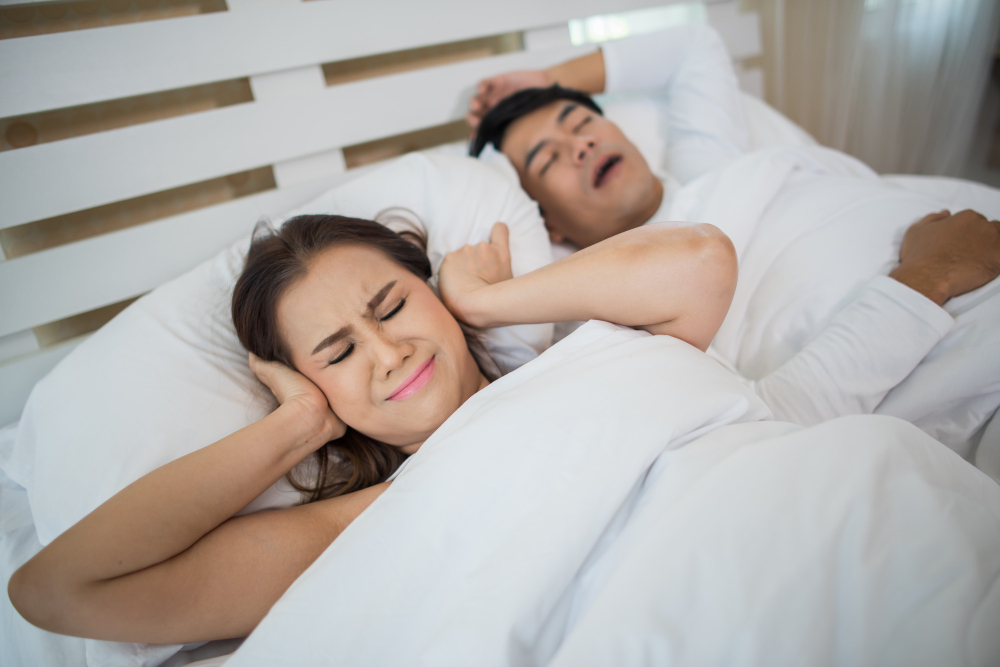
What snoring actually is
Snoring is a sound, not a diagnosis. When you fall asleep, the muscles holding your airway open relax. If the space narrows enough, air moving through it makes the soft tissue at the back of your throat vibrate. That vibration is the noise.
Plenty of things narrow that space: nasal congestion, a deviated septum, enlarged tonsils, alcohol before bed, sleeping on your back, extra weight around the neck, or simply the shape of your jaw and tongue. Snoring on its own means air is still getting through, just noisily.
Sleep apnea is different in kind, not degree. In obstructive sleep apnea the airway does not merely narrow, it collapses shut. Breathing stops, oxygen drops, and your brain briefly wakes you enough to reopen the airway. Then you fall back asleep and it happens again, sometimes dozens of times an hour, all night, with no memory of any of it in the morning.
So snoring is a symptom that sometimes accompanies apnea and sometimes does not.
Why loudness is a poor test
This is the part that misleads people most.
Some of the loudest snorers I meet turn out to have no apnea at all. Their airway vibrates and nothing else happens. Meanwhile some patients with significant apnea are quiet sleepers, or their partner reports gasping and silence rather than sawing. Women in particular are underdiagnosed, partly because the classic loud-snoring picture does not always fit.
The signs worth paying attention to are less about volume and more about the pattern and the aftermath. Pauses in breathing that a partner has noticed. Gasping, choking, or snorting awake. Waking with a dry mouth, a headache, or a sore throat. Needing the bathroom several times a night. Being tired after a full night in bed, falling asleep in meetings or at red lights, or having a fuse noticeably shorter than it used to be.
If a partner has described watching you stop breathing, that is the single most useful piece of information in this whole article. Take it seriously.
Why a dentist is often the first to raise it
I look inside a lot of mouths, and mouths keep records.
Worn or flattened teeth, especially with no history of a grinding diagnosis, come up frequently in patients who turn out to have breathing issues. The body clenches and repositions the jaw to reopen a closing airway, and the teeth absorb that. Along with it comes a scalloped edge along the sides of the tongue, dry mouth, a small or narrow upper arch, a tongue that fills the whole space when you open, enlarged tonsils, and morning jaw soreness. Reflux is common too.
None of those prove apnea. Together they justify asking the question, and that question often does not get asked otherwise, because most people never mention snoring to a doctor. It feels like a personality trait rather than a medical finding.
The thing I cannot do
To be clear about the limits: a dentist cannot diagnose sleep apnea. Neither can an app, a smartwatch, or a snoring-sound recording. Those can flag a pattern worth investigating, and that is genuinely useful, but they do not measure what has to be measured.
Diagnosis requires a sleep study, either a home test or an overnight in-lab study, interpreted by a physician. That is what establishes whether apnea is present and how severe it is, and severity is what determines the right treatment. Skipping that step is how people end up treating the wrong problem for years.
What we do at Core Smiles is screen, ask the questions that get skipped elsewhere, and coordinate with a sleep physician for testing. Treatment decisions come after the results, not before.
Where the real harm comes from
Here is the distinction that matters most, and it mirrors what I say about whitening products.
Over-the-counter anti-snoring mouthpieces. Boil-and-bite devices sold online hold the lower jaw forward with no assessment of your joints, your bite, or your teeth. Two problems follow. They apply uncontrolled force, and over months that moves teeth and can change how your bite comes together, sometimes permanently. And they can quiet the snoring while the apnea continues underneath, which removes the one symptom that would have sent you to get tested. A silent airway that is still collapsing is worse than a noisy one, because now nobody is worried.
Nasal strips and sprays used as a solution. They can help genuine nasal obstruction and they are harmless. They do nothing for a collapsing airway, and used as a substitute for evaluation they cost you time.
Assuming it is only a snoring problem. Untreated obstructive sleep apnea is associated with meaningful strain on the cardiovascular system and with the daytime impairment that comes from never reaching restorative sleep. This is the one item on the list where waiting has a real cost.
Properly fitted appliances are a different category entirely. A custom oral appliance is designed from your own records, adjusted in small increments, and monitored over time specifically so bite changes get caught early. That monitoring is the difference between a medical device and a gadget.
What treatment actually looks like
It depends on severity, which is why the testing comes first.
CPAP remains the most effective option for moderate to severe apnea and is usually where a sleep physician starts. It works when it is worn, and the honest problem with it is that a lot of people cannot tolerate it.
Oral appliance therapy is a well-established option for mild to moderate apnea, for primary snoring, and for patients who cannot use CPAP. The appliance holds the lower jaw slightly forward during sleep, which keeps the airway open. It is small, quiet, needs no power, and travels easily, which is why compliance with it tends to be high.
Some cases call for an ENT evaluation for nasal or tonsil issues, and side sleeping, alcohol timing, and weight are all factors that legitimately move the needle for some patients.
Because appliances work by repositioning the jaw, jaw joint function gets evaluated first and rechecked as we go. Existing joint problems do not rule out an appliance, but they change how it is designed and adjusted.
What this means practically
Snoring and sleep apnea are not the same thing, and volume tells you very little about which one you have. The only way to know is a sleep study, and the reason to bother is that one of these conditions is a nuisance and the other quietly taxes your heart and your waking life.
If you snore and wake up tired, or someone has watched you stop breathing, that is worth a conversation. We can screen for it during a regular visit in NoMad, look at what your teeth and airway are already telling us, and get you to the right test.
Snoring and waking up tired? Schedule a consultation at Core Smiles.